
When an amber warning lamp blinks on the instrument cluster of your excavator or wheel loader, stopping the job costs money every minute. A Cat ECU communicates engine trouble using a three-part diagnostic code consisting of MID (Module Identifier), CID (Component Identifier), and FMI (Failure Mode Identifier). This standardized sequence tells you exactly which computer flagged the issue, which circuit or sensor failed, and whether the fault is an open wire, a short to ground, or a mechanical breakdown.
Understanding how to decode these signals keeps equipment on schedule, prevents guesswork in parts buying, and protects diesel engines from catastrophic failure.
The Anatomy of a Cat Fault Code
Caterpillar machinery does not spit out random error numbers. Every digital fault code follows a structured string established across Caterpillar electronic control architectures.
[MID] – [CID] – [FMI]
Example: 036 – 0100 – 04
Each segment isolates a distinct piece of the diagnostic puzzle:
- MID (Module Identifier): Indicates which electronic control unit on the machine data network is broadcasting the alert. According to Integrated Publishing Maintenance Documentation, 2024, MID 036 designates the primary Engine Control Module (ECM). If your readout shows MID 027, the transmission control is signaling; MID 082 points to the electronic implement control.
- CID (Component Identifier): Pinpoints the specific physical component, circuit, or sensor generating the fault. A CID 0100 points directly to the engine oil pressure sensor circuit, while CID 0110 refers to the engine coolant temperature circuit.
- FMI (Failure Mode Identifier): Defines the exact electrical or mechanical failure occurring on that component. The diagnostic standards documented by MechLink Diagnostic Lookup, 2026 outline how FMIs translate electrical behavior:
| FMI Code | Failure Mode Description | Common Real-World Cause |
| FMI 00 | Data valid but above normal operational range | Severe overheating, overpressure |
| FMI 01 | Data valid but below normal operational range | Dangerous oil pressure drop |
| FMI 02 | Data erratic, intermittent, or incorrect | Loose harness pin, electrical noise |
| FMI 03 | Voltage above normal or shorted high | Broken ground wire, open sensor circuit |
| FMI 04 | Voltage below normal or shorted low | Pinched signal wire touching engine frame |
| FMI 05 | Current below normal or open circuit | Disconnected plug, burnt solenoid coil |
| FMI 11 | Failure mode not identifiable | Multiple simultaneous sensor circuit dropouts |
| FMI 12 | Bad device or component | Internal microchip or ECM processor failure |
When an operator sees 036 – 0100 – 04, the code translates directly: the Engine ECM (MID 036) detected that the Engine Oil Pressure Sensor circuit (CID 0100) has dropped to a voltage below normal or shorted to ground (FMI 04).
How to Pull Cat ECU Diagnostic Codes
You do not always need a service laptop hooked up to pull active codes in the field. Depending on machine age and cab electronics, technicians use three primary methods to access Cat diagnostic codes:
- In-Cab Digital Displays: Modern Caterpillar machinery equipped with Messenger displays, Advisor panels, or Next-Gen touchscreen monitors allows operators to access active codes directly through the settings menu. Navigating to Service > Diagnostics > Active Events reveals active faults with their MID, CID, and FMI readouts without external hardware.
- Dashboard Diagnostic Flash Codes: On mechanical and electronic transitional engines like the 3126B, 3406E, or early C15 models, the instrument panel uses flash codes. Turning the ignition key to the ON position and holding the in-cab diagnostic test switch prompts the yellow warning lamp to flash.A sequence of two flashes, a brief pause, and four flashes indicates Flash Code 24 (which corresponds to an intake air pressure sensor fault). Technicians then use a Caterpillar cross-reference chart to convert the flash count into its digital MID-CID-FMI counterpart.
- Caterpillar Electronic Technician (Cat ET): For complex, intermittent electrical faults, connecting Cat ET through a Cat Communication Adapter 3 (CA3) into the 9-pin or 14-pin diagnostic connector remains the industry standard. Cat ET displays live telemetry, logs transient spikes, and performs cylinder cut-out tests to isolate dead injectors.
The Sensor Glitch That Fools Technicians
The single most expensive diagnostic mistake in heavy equipment maintenance is replacing a sensor the moment its CID appears on screen.
In harsh working environments with high ambient heat, blowing sand, and heavy chassis vibration, copper wiring and harness plugs take continuous punishment. An FMI 03 (voltage above normal) or FMI 04 (voltage below normal) indicates that the circuit voltage is outside operating thresholds. More often than not, the sensor is functional, but the harness has rubbed bare against the engine block or corroded inside the weather pack connector.
Before purchasing replacement parts, follow this basic bench routine:
- Check 5-Volt Reference Voltage: Unplug the sensor harness and measure the DC voltage across the power supply pins with a digital multimeter. The Cat ECU should output a regulated 5.0V (+/- 0.2V) reference signal. If this voltage is missing, the wiring loom or the ECM internal power rail is damaged.
- Inspect Ground Continuity: Measure resistance between the sensor ground wire and the engine chassis ground. Resistance must stay below 1.0 ohm. Higher values point to oxidized ground studs or cracked splices.
- Simulate the Opposite Fault: If the active code is FMI 04 (short to ground), unplug the sensor. If the code shifts to FMI 03 (open circuit / high voltage), the wiring harness is intact and the sensor itself has shorted internally. If the code remains FMI 04 with the sensor completely disconnected, the signal wire is shorted to the frame somewhere between the plug and the ECU.
When to Repair Wiring Versus Replace Modules
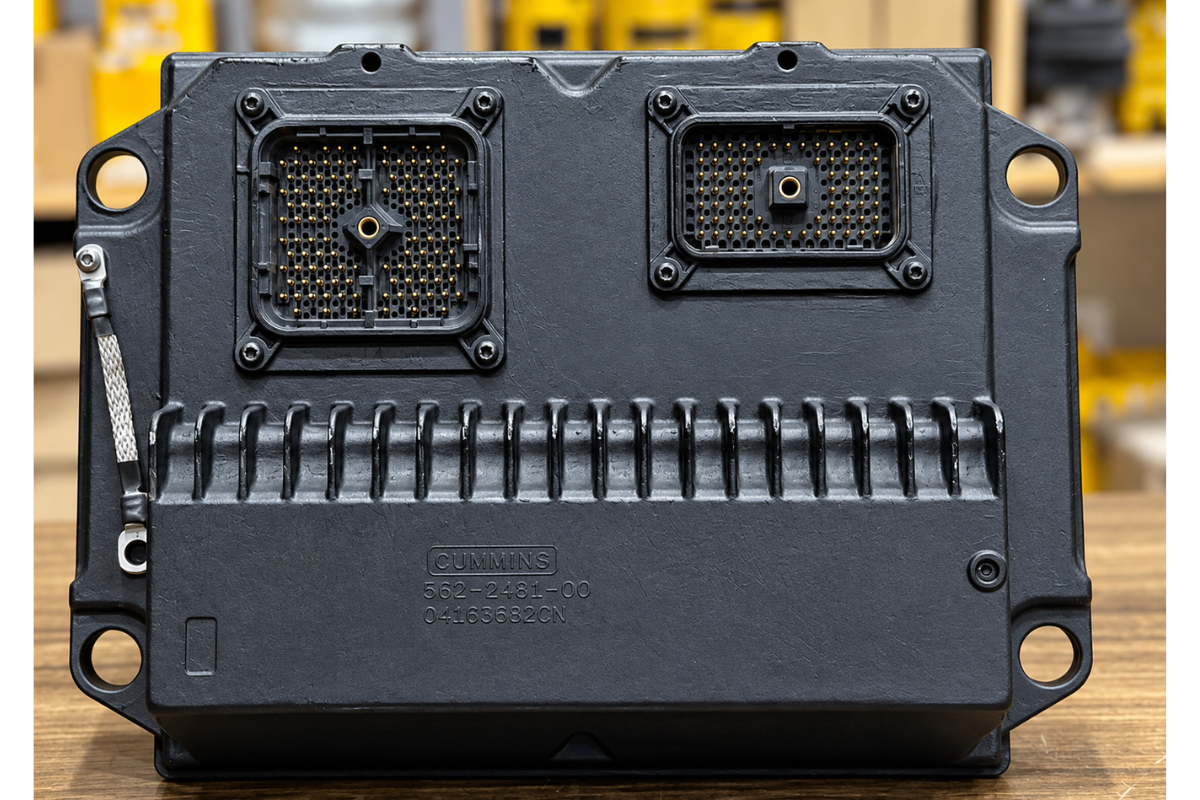 While damaged wiring harnesses account for over half of intermittent fault codes, the ECU itself can degrade over thousands of operating hours. Continuous thermal cycling, alternator voltage surges, and moisture penetration eventually take their toll on the internal circuit board.
Replace the module when you observe:
- Persistent FMI 12 Codes: If MID 036 reports FMI 12 (bad device or component), the internal microprocessor has failed its internal self-check or corrupted its onboard memory.
- Lost 5V Sensor Rails Across Multiple Unrelated Sensors: When temperature, oil pressure, and fuel rail pressure sensors all flag voltage faults simultaneously, the ECM internal voltage regulator has likely burnt out.
- Communication Bus Dropouts: If Cat ET cannot establish communication through the Cat Data Link (CDL) or J1939 CAN bus despite verified power and ground supply at the ECM pins, the communication transceiver chips have failed.
When an engine control module requires replacement, sourcing direct-fit OEM replacement units from specialist distributors like Al Burhan Heavy Equipment Spare Parts prevents multi-week OEM dealership backorders and gets heavy equipment back into production.
Frequently asked questions
What is the difference between active and logged Cat fault codes?
An active fault code indicates a problem present right now, which often illuminates a dashboard warning lamp or triggers an engine power derate. A logged fault code records past intermittent faults that resolved themselves, helping mechanics pinpoint historical sensor dropouts, temperature spikes, or loose wiring pins.
Can I clear a Cat fault code without Cat ET software?
Active codes cannot be cleared manually while the electrical or physical fault persists; once you fix the root problem, active codes clear automatically. However, clearing historical logged codes from ECM memory requires connecting Caterpillar Electronic Technician (Cat ET) software or an authorized heavy-duty commercial diagnostic scanner.
How do I know if my Cat ECU has completely failed?
A failed Cat ECU typically causes complete engine cranking without startup, sudden shutoffs under load, or a refusal to communicate with in-cab displays and Cat ET. If multimeter testing confirms battery voltage and ground at the ECM connector pins but the module remains totally unresponsive, the unit has failed.


