
Nothing ruins a productive morning on the job site faster than an excavator that stumbles under load or fills the air with thick, dark smoke. A failing Cat injector reveals itself through four clear warning signs: unusual exhaust smoke, rough idling with power loss, hard morning starts, and a rising oil level on your dipstick. Catching these early symptoms protects your engine from cylinder wash and scuffed liners before a minor repair becomes a full rebuild.
At Al Burhan, we talk every day with fleet owners and mechanics across the UAE who could have saved serious money if they had pulled a weak injector a week earlier. Let us look at what your machine is doing, what those symptoms mean, and how to test your equipment before you buy any parts.
The Smoke Signals Coming from Your Exhaust
Your exhaust stack is usually the first place an injector problem shows up. When an injector nozzle gets clogged, worn out, or stuck open, the fuel spray pattern falls apart. Instead of a fine, even mist that burns cleanly, you get heavy droplets or raw fuel dumping straight into the combustion chamber.
Pay close attention to the color of the smoke puffing out of the stack:
| Smoke Color | What Is Happening in the Cylinder | Most Likely Injector Problem |
| Black Smoke | Too much fuel is burning with too little air | The injector nozzle is worn or sticking open, dumping excess diesel |
| White Smoke | Raw, unburnt diesel is blowing straight through the exhaust | The injector is not firing correctly, atomizing poorly, or mistimed |
| Grey Smoke | Partial burning of fuel under incomplete combustion | An uneven spray pattern or a clogged tip causing a partial burn |
Black smoke often tricks operators into thinking their turbocharger has failed. While a tired turbo can cause black smoke, a bad injector tip dripping fuel leaves a distinct diesel smell and causes a sharp jump in your daily fuel burn.
Why Is Your Engine Oil Level Rising?
Pull your engine dipstick. If the oil level sits well above the full mark, do not just wipe it and keep working. Sniff the oil on the stick. If it smells like diesel fuel, you have an urgent problem.
When an injector gets stuck wide open or its external body O-rings split, diesel washes past the piston rings and drains into the oil pan. This problem is known across the diesel industry as cylinder wash. As explained in the G2 Diesel Products Technical Bulletin, 2025, unburnt diesel fuel strips the protective layer of motor oil right off the cylinder walls. Without that oil film, piston rings rub metal-to-metal against the cylinder liner, causing severe scuffing and eventual piston seizure.
Worse yet, thin diesel-soaked oil cannot protect your crankshaft bearings or camshaft lobes. Running a machine with fuel-diluted oil for even a few hours under heavy load can destroy the entire bottom end of the engine.
Rough Idling and the Cylinder Cutout Test
Does your machine shake in the cab when idling, or bog down the moment the hydraulic pumps demand power? That rhythmic shudder usually means one cylinder is not pulling its weight.
A failing Cat injector cannot meter fuel accurately under pressure. At low idle, the engine stumbles. At high throttle, it feels sluggish and unresponsive. Before you pull the valve cover and start unbolting parts, you can narrow down the culprit using two simple methods:
- The Infrared Temperature Gun Check: Point an infrared thermometer at each exhaust manifold runner right where it bolts to the cylinder head while the engine is running. A healthy cylinder runs hot. If you find a runner that is significantly cooler than the others, that cylinder is misfiring because its injector is not delivering fuel.
- The Cat ET Cylinder Cutout Test: If you have access to diagnostic software, running an automated cylinder cutout test makes life easy. As detailed in the Scribd Heavy Machinery Maintenance Library, 2024, this electronic test cuts fuel to each cylinder one at a time while measuring engine speed. When the software cuts a good cylinder, engine RPM drops noticeably. When it cuts the bad cylinder, the engine sound and RPM barely change, instantly pinpointing the weak injector.
What Causes Cat Injectors to Give Up?
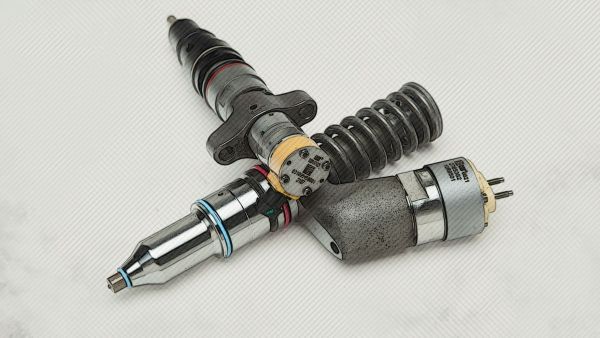
Modern Caterpillar fuel systems run under intense pressures, often exceeding 25,000 to 30,000 PSI inside the nozzle. At those pressures, even tiny mistakes in maintenance take out precision fuel components fast:
- Dirty Fuel and Fine Dust: Fine sand and abrasive grit act like liquid sandpaper against internal injector valves. Once the micro-finish on the needle seat wears down, the injector begins to leak.
- Water in the Fuel Tank: Water ruins high-pressure diesel injection. It strips lubrication from internal plunger surfaces and causes immediate rust pitting inside the nozzle tip.
- Cheap or Old Fuel Filters: Off-brand fuel filters with incorrect micron ratings let microscopic grit slip into your fuel rail. Always stick to recommended micron ratings for primary and secondary filters.
- Baked O-Rings from Desert Heat: Extreme ambient temperatures bake the rubber O-rings that seal the injector body against the cylinder head. Once those seals harden and crack, fuel leaks straight into the crankcase.
Should You Replace One or the Full Set?
This is the question every equipment owner asks when an injector fails: Can I replace just the bad one, or do I have to buy all six?
Here is the practical rule of thumb:
- Replace just the single injector if your engine had a full injector overhaul recently (under 2,000 hours) and suffered an isolated electrical solenoid failure.
- Replace the complete set if the injectors have logged 8,000 to 10,000 hours or if dirty fuel contaminated the entire fuel system. When all six injectors have lived through the same hours and dirty fuel, the remaining five will usually fail within a few weeks of the first one. Replacing them together saves you repeated labor charges, downtime, and lost machine-rental revenue.
When you need replacement units, sourcing verified OEM or high-grade aftermarket injectors from Al Burhan Heavy Equipment Spare Parts ensures you get properly calibrated nozzles with fresh seal kits ready for installation without long dealership waits.
Frequently asked questions
Can dirty fuel ruin a Cat injector right away?
Yes. Fine abrasive dirt or water passing through a low-grade filter can scratch the microscopic tolerances inside an injector valve in just a few hours of operation. That tiny scratch stops the needle from sealing completely, leading to continuous fuel dripping, heavy smoke, and misfiring.
Should I replace all Cat injectors if only one is bad?
If your injectors are relatively new and one failed due to an electrical glitch, replacing just that unit is fine. However, if your injectors have thousands of hours on them, replacing the whole set is much smarter because the remaining injectors will likely fail shortly after.
How many hours should a Cat injector typically last?
With clean fuel, regular filter changes, and proper operating temperatures, quality Caterpillar injectors routinely last between 8,000 and 12,000 hours. Contaminated fuel, water in the tank, or poor filtration can cut that working life to less than 3,000 hours.


